| Certain
compounds, namely organic compounds, which have high boiling
points can be distilled by using steam distillation. Steam
distillation is the process of purifying a substance through
application of steam to them. Basically that means steam
distillation purifies stuff by heating something with
steam. This process is mainly used to extract essential
oils from their associated natural sources, e.g Eucalyptus
oil from Eucalyptus leaves. |

Typical
distillation setup in the lab
|
|
Steam
distillation works on the principle that immiscible
objects when mixed together can lower the boiling point
of each other.
Historically
and in some regions of the world today essential oils
were obtained by a rather primitive and ugly process.
By boiling some organic matter with water and then condensing
the resultant vapour/gas, one can obtain some essential
oils.
|
Firstly
I decided I would make the condenser.
A condenser is usually made out of glass but as I don’t
magically produce glass with perfect cuts and fits I
made my own design. |
|
|
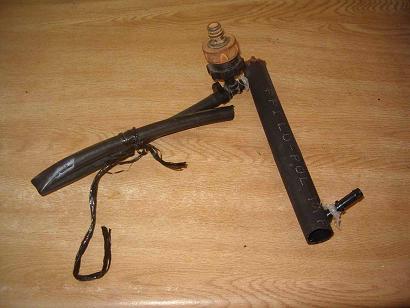
Now, I
can be what some consider impulsive so in one night
I came up with this pile of rubbish made from garden
hose and, well, other rubbish. Garbage in = garbage
out, folks.
|
After realizing
the complete hopelessness of ever using something
like that I rebuilt my condenser in a more planned,
sturdier, and definitely better way.
The wonders
of PVC and the ability to weld it easily made the
construction of this quite easy. The only non-plastic
component of this is the copper condensing tube on
the inside of the water jacket.
|

PVC Condenser |

A primitive olive
oil evaporation chamber |
Once
the condenser was constructed the only thing left to
make was a boiling chamber. My first few attempts resulted
in an olive oil bottle with a piece of PVC pipe shoved
down its neck. The problem with this was that I could
not directly apply heat as it was just glass bottle
rather than a borosilicate laboratory-grade piece of
glassware. Direct heating may lead to explosions, which
are neither pretty nor welcome. However there is never
any fun without risk, so away we go! |
| I have
performed two distillations so far- lemon grass and
aloe vera. Both produced rather nice smelling solutions
of oil and water. So it appears that very simple equipment
can lead to impressive results! |

Evaporation chamber
with lemon grass |
|
This
is the entire setup. Crudely constructed, on the left
a standard BBQ burner is visible. The evaporation chamber
sits on top, and steam is channeled into the condenser
tube.
And
there you have it. A simple, 15-minute lashup which
can bring you hours of perfume joy. Away with Chanel
no.5!
Article
Author: Nick - contact here |