The art
of high speed photography must be one of the most
interesting ways that photography can represent things
we see, and don't see, everyday. Photos of bullets
piercing armour, hammers smashing watermelons and
pins pricking balloons are all possible due to the
technological advances in cameras.
There is,
however, a cheap and dirty way of producing high quality
high speed photographs at home, and this is what I
want to show you here! This method uses no special
cameras and likely costs less than a thriller novel.
Any camera
which can be set on 'exposure priority' mode will
work. Basically, in this mode, the user can manually
set how long the camera shutter opens. Generally a
few seconds will do the trick. To put this in contrast,
a picture shot outdoors in broad daylight will generally
have an exposure time something like 1/500th of a
second. The key in our setup is darkness - the camera
and scene is setup in darkness, and the only light
comes from a sound activated flash unit.
|
This
is the crude setup which I used. The red device is a
custom sound activated flash unit which I put together
using an old camera flash unit (careful with these...),
a microphone, and an amp circuit.
The
red cross is where the camera is placed to capture the
action and the blue circle is where the 'action' takes
place. |

|
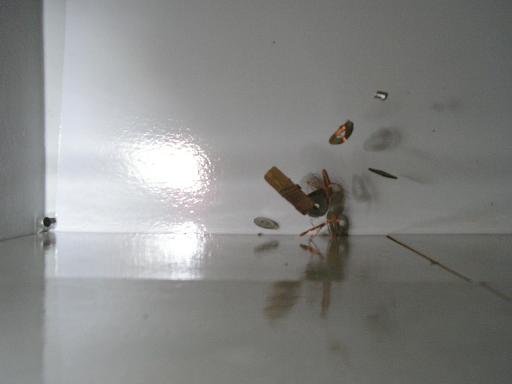
Here is
one of the earliest photos during the testing phase.
This is just some random stuff being dropped onto the
tiles.
Notice how
nothing has hit the surface. You're probably thinking,
then how on earth did the sound trigger get activated?
Well in fact,
the COIN has hit the floor, except there is a tiny delay
between sound activation and the flash caused by a relay,
so the coin you see is actually bouncing back UP. |

|
More
junk being dropped. The microphone is visible on the
left.
That
over-exposed section on the backboard is caused by the
uneven spread of the flash lamp - I must make a diffuser
of some kind. |
|
Coins being
dropped onto the tiles.
The flash
is activated the moment the small 5 cent coin at the
bottom hits the floor whilst the other coins are still
falling. |
|
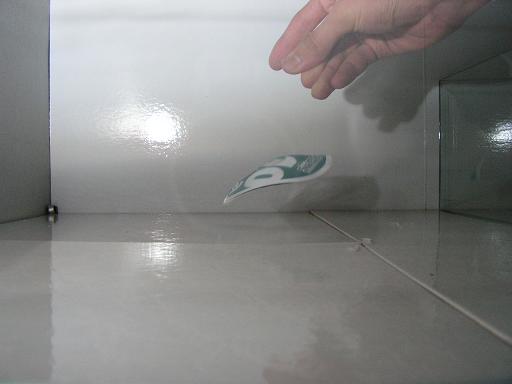
I
never thought this would be caught in action...
An
attempted snapping of a CD, but instead it bent and
flew out of my hand very quickly.
Of
particular interest is the 'flexing' motion of the CD
caught in still-motion! This setup is working well! |
|
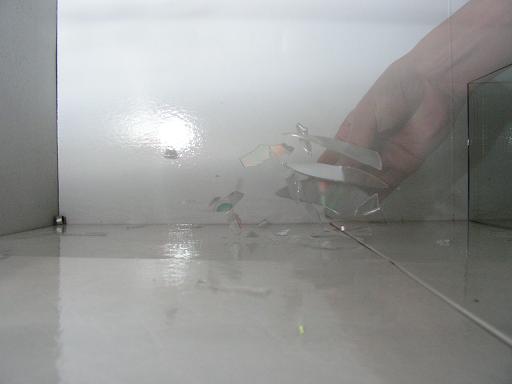
A more
successful CD snapping. Bits going everywhere... The
flash was triggered twice in this exposure, because
some of the CD shards hit the microphone after the first
flash. This explains why the scene appears "ghostly". |
|
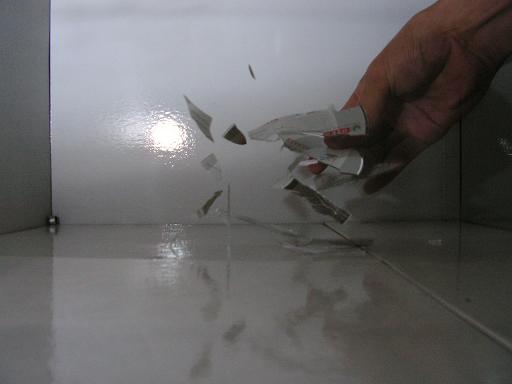
Similar
to the above. This is a better exposure, however. Different
CD, obviously... |
|
The lightbulb
smashing photo is a classic, and I couldn't resist doing
one. This is a very weird one, because the bottom half
of the bulb is already gone, but the glass hasn't risen
up in the air yet.
The perfect
bulb smash photo was never taken, because the flash
trigger was relatively too fast, and the glass never
had enough time to break up properly. |
|
The
poor giraffe starting to fall after being hit at high
speed by a flying elephant. |
|
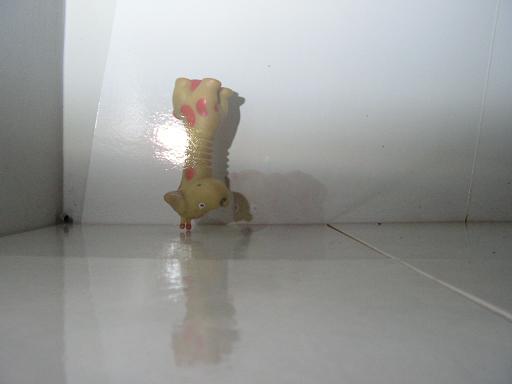
The poor
giraffe once again, this time doing a handstand. |
|
A
wire spool and an elephant were thrown together.
I
love this one, and it is a classic stroboscopic example.
The flash in this exposure was triggered 3 times, and
each time the camera recorded the location of both objects.
As
you can see, the elephant was brutally thrown off the
wire spool and hit the corner. |
|
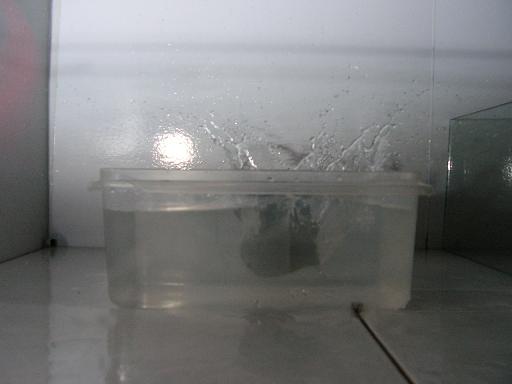
The elephant
being dunked in water at very high speed.
It is difficult
to obtain correct exposure of these photos, given the
lighting is intense and short-lived. It appears the
only real solution is software correction, but perhaps
a brigher flash unit along with a diffuser would help. |
|
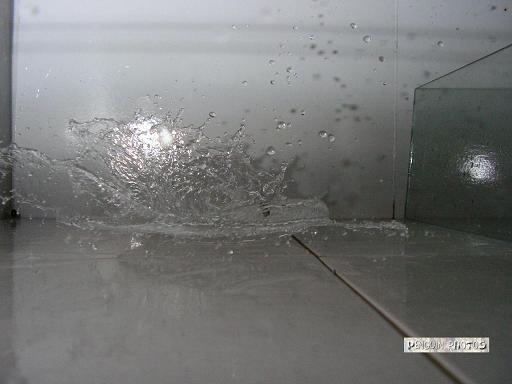
My
favourite high speed photo - water being splashed onto
a glass dish. |
|
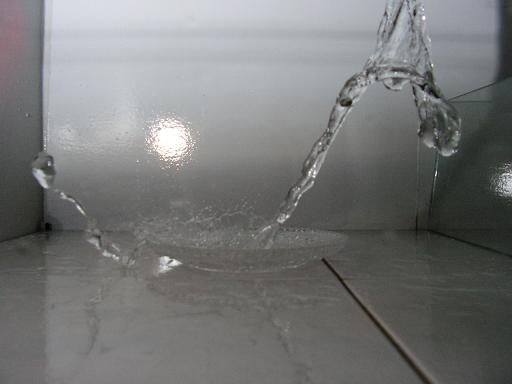
This
one is kinda spooky. Here the stream of water which
first hit the dish triggered the flash while the rest
was still falling. |
|
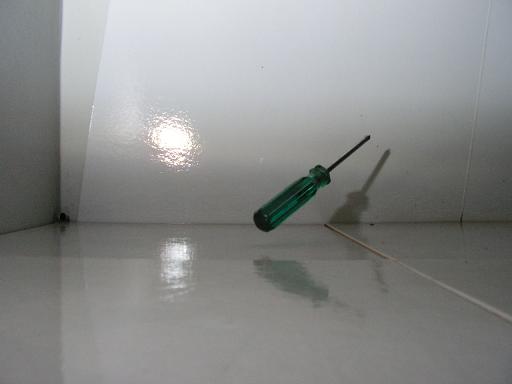
Here
is a great demonstration of flash delay. The screwdriver
has already hit the surface, but has bounced back up
by the time the flash is triggered. This is due to the
time it takes for the relay to switch on and trigger
the xenon flash lamp to arc. |
|
This
is a zoomed-in image of the same ceramic statue that
was shot by the Coilgun a
few weeks prior. I decided it wasn't worth anything
anymore so I dropped it. At the time I felt like breaking
something anyway, which is what this whole section is
about.
Notice
the fine grains of porcelain being chipped off while
a large verticle crack forms in the body.
There
is another type of high speed photography which requires
even less setup and equipment - check out part
II. |
|