Induction
cooktops used to be mythological items which existed
only in dreams. Now they are common-place in kitchens
and stoves around the world. Induction cooktops are
fairly unique kitchen appliances that have become commonplace
in many households.
Magically,
the innocent looking piece of glass which you call an
induction cooktop heats your food with no smell, no
noise, no obvous heat source - nothing!
|

A typical induction cooktop
(Image
courtesy of Proidee UK)
|

|
When an
alternating electric current is passed through a coil
of wire, the coil creates a magnetic field. The magnetic
lines of flux cut through the air around the coil. If
a ferrous material, such a solid bar of iron is inserted
into this coil, electrical currents known as eddy currents
are induced to flow in the metal bar. This causes localized
heating of the bar.
In an induction
heater, the coil is known as the 'work coil', and the
ferrous material usually presents itself in the form
of a metallic saucepan.
But lets
start from scratch and see what we can do with some
DIY induction heating! |
Remember
the Ignition coil driver
of mine? It just so happens that it is designed to send
an AC current of variable frequency into a coil, and
that made it perfect for induction heating.
So
to make the work coil, a meter or so of #16 gauge copper
wire was tightly wound with a total 40 turns.
The
coil driver was then modified and tuned in frequency
to suit the new work coil. |
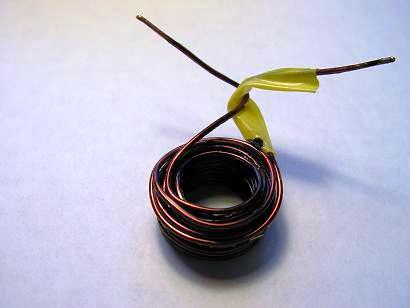
Work coil made from enamelled
copper wire |
|
Success!
With an input voltage of 24V, at 3A, it took about 30
seconds to heat a small bolt red hot.
Notice that
only the section of the bolt inside the work coil is
experiencing heating effects - heating is very localised.
I had to
mount the work coil on a ceramic (tile) base as it had
started to melt bits of my work bench. |
A
hexagonal screw in the red hot zone. Estimated at ~700°C
from the colour of the steel.
Input
frequency is ~300kHz for the coil. This seems to deliver
maximum heating power. |
|
|
And...
remember those 'bullets' from the coilgun?
Well here is one heated red hot. These took a bit longer
than the screw to heat up, presumably due to their larger
volume. Perhaps also something to do with the material
too. |
Unfortunately,
during the last run of the induction heater, a MOSFET
exploded.
Someday
I would like to get a bigger, better induction heater
going to hopefully melt some steel.
|
|


