A
Marx Generator is a device commonly utilized in museums
and labs to simulate and demonstrate the effect of
lightning.
Examining
the effect of lightning can be useful, not only to
advance the understanding of lightning, but also to
physically test electronic components such as insulators,
high voltage capacitors etc etc.
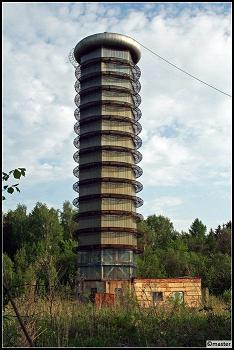
A gigantic
Marx Generator tower in Russia
(Image courtesy of unknown author -
'master')
A Marx
Generator basically consists of a very clever way
of charging and discharging capacitors such that the
output voltage is a multiple of the input voltage.
A typical
Marx Generator schematic is shown to the left. It
isn't hard to see that the input supply (left-most
terminals) charges up the capacitors in parallel.
After some time, the capacitors are all charged to
the supply voltage.
The terminals
in between each 'stage' is a spark gap. The spark
gaps are set to a distance so that they will 'fire',
or conduct, as soon as the capacitors are charged
to supply voltage.
Because
of the way they are arranged, when the spark gaps
fire the capacitors are essentially discharged in
series. Thus, the output voltage is (theoretically)
a multiple of the input voltage equal to the number
of capacitor stages in the Marx.
I
decided to make a small scale Marx Generator. For this,
I ordered 20 pieces of 1nf, 20kV rated capacitors from
eBay, and they arrived in perfect condition. Given their
construction, however, it appeared they probably wouldn't
stand 20kV before arcing between the leads, so I knew
there was preparation work to do.
Grabbing
some oxygen free copper cable, I removed the copper,
and threaded the capacitor leads through. A perfect
fit, and would definitely insure me against spark overs.
I went
for a simple approach. All parts were crudely soldered
onto each other on top of a fibre ceramic board, a good
insulator. Each of the 1M resistors was made out of
two 470K, 1W resistors in series. Close enough.
Spark gaps
were constructed, somewhat resourcefully, using the
long leads of the resistors. The tips were carefully
bent into U shapes to minimize coronal loss.
And here
is a test run with 6 stages and the spark gaps set very
conservatively. So far, so good.
The
high voltage charging supply which I used was based
on a flyback transformer using the same driver as the
ignition coil driver.
This flyback transformer was salvaged from an old computer
monitor, but you can find them in most old CRT TVs also.
The
output voltage of this supply is approximately 10kV.
I increased this later.
After a
while, I ran out of resistors. Which is sad, because
I only got up to 10 stages.
Anyway 10
stages should theoretically give me an output voltage
of 100kV with a 10kV supply. Not too bad. Lets put that
to the test...
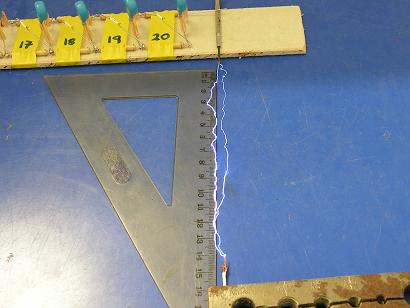
Here
we go! Ruler indicates ~9cm spark length. Which means
approximately 99kV. Pretty close.
This
really surprised me as it meant that I was incurring
very little loss in the circuit. However, in hindsight
it occured to me that this these were probably surface
tracking sparks given the proximity to the benchtop.
The
Marx fires about twice a second. Oh, here's also a short
video to give you an idea of what happens...
Output
sparks in the air... This was a 2.5 second exposure
and there are 5 full length sparks visible, indicating
that the firing rate is indeed approximately 2 times
per second.
I just
could not resist. Mr. Penguin is fortunately made
out of plastic, although you can see that one of the
sparks has leaked a bit of corona just under his beak...
The sparks tend to snake around the penguin... again,
surface tracking.
Dull sparks, but I really
like this one. A perfect demonstration that plastic/acrylic
sheeting or other common household insulators are
completely useless at such high voltages.
The spark snakes around
a bit then goes straight through the plastic film
as it if wasn't there. I was really expecting a few
surface tracking sparks but this did not occur.
Here,
we have a better demonstration of surface tracking using
a thicker piece of perspex.
Got
the new resistors, and added ten extra stages. The Marx
Generator now consists of 20 stages. The hissing noise
of the corona is very audible, and the spark length
much less than the theoretical.
The extra
stages add on an extra 4cm to the previous spark length.
A maximum of 14cm spark length now indicates an approximate
output voltage of 150kV.
The effect
of surface tracking is again an issue in hindsight
here. Realistically the voltage is probably less than
150kV.
Polystyrene
balls are great indicators of static electricity,
and are commonly seen used in 'rub-the-plastic-ruler-with-wool-and-pick-up-stuff'
experiments. Load the video to see what happens when
the marx generator charges up a whole container of
these!
Here
we have a bit of fun with the Marx.
I've
always wondered why on earth people think that the
rubber tires of a car is what saves them from being
stricken by lightning.
Because
they're wrong! Given that the lightning bolt has travelled
more than a kilometer through the sky, is one inch
of rubber going to do much? Lightning cannot strike
you in your car because the metal chassis of the car
acts as a Faraday cage - the charge flows on the outside
of the metal rather than the inside, which is where
you are!
Old-school car getting struck
Eiffel Tower having a bad
day
Old-school iPod having an
even worse day
To
everyone who hates ipods! This one was kindly donated
to me by Charles. It was already broken through, had
a cracked screen, and I had already salvaged the hard
drive off it earlier. For the relief of those iPod
lovers, you may remember the laws of the Faraday cage!
This setup
shows how the Marx output wires are connected during
the lightning simulations.
The yellow
wire is at high voltage, whilst the white one just
visible down the bottom is the ground wire, which
in this case is attached to the iPod metal casing.