Gone
are the days of the glorious incandescent bulb from
the times of Thomas Edison. Nowadays the transition
away from these instantly recognisable objects signifies
a change in global environmental awareness, with the
incandescent bulb being the worst offending lighting
device.
Here
we take a quick look at some more advanced lighting
technology. |

|

Typical small halogen bulbs
for lamps
|
The
Halogen Bulb
Halogen
bulbs are basically the same as incandescent bulbs,
but have added halogen gases to increase efficiency.
These operate at much higher temperatures, and for this
reason it is generally a bad idea to substitute halogen
bulbs into torches designed for incandescent bulbs,
unless you want to end up with a puddle of plastic at
your feet. |
I
got a few of these bulbs and did a 5-minute lash up
job, as seen in the picture. These bulbs operate on
12V, and are rated at 50W each. The bundle there is
therefore a hefty 200W mini light monster. |
|
|
Upon
power up, the first feeling is that the heat is terribly
intense. You can feel it about a meter away.
I've
killed ants about 10cm away just with the heat that's
emitted from this thing. If left on for more than half
a minute, the plastic base would start to melt. |
The
CCFL tube
I
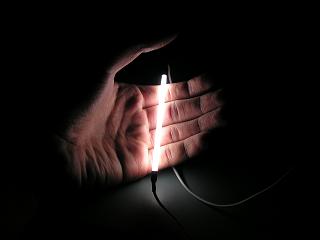
bet you've never even wondered what kind of lamp lights
up your computer monitor - a CCFL (cold cathode fluorescent
light) does that job.
Here
is one I got a while ago... Pure white light emission,
and much more efficient than the good old edison bulb.
|
|
|
To power
these things up, you need an inverter circuit. This
is simply a circuit which turns low voltage DC into
higher voltage AC to supply the tube. In many ways,
this is a simplified version of the Penguin's Lab fluoro-tube
driver. |
The
Sodium Vapour Bulb
If
you really like yellowish light, then this bulb is for
you. Low pressure sodium vapour bulbs are the most efficient
light bulbs that we have, and in fact even surpasses
the efficiency of high-tech LED's.
As
seen in the graph... sodium light is very close to the
maximum sensitivity point of the human eye, one of the
reasons why they boast such high efficiencies.
Sodium
lights are found in streetlights all over the world. |

(Image courtesy
of LampTech UK) |
|
I happened
to find a nice collection of 8 sodium vapour lamps at
the uni that noone wanted anymore. Out of the 8, only
2 were still operational, so the rest were kept for
a bit of glass smashing fun later on.
Sodium lamps
have a long warm up time, about 5 to 10 minutes, so
I imagine it would really suck to have one as a desk
lamp.
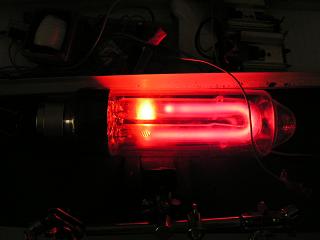
Here is one
of the operational sodium lamps during the warm-up phase.
I don't recall how exactly I rigged up the driver for
this. |
And
during proper operation....
Sodium
light is the worst for colour identification due to
its monochromatic output. Everything that is illuminated
by sodium light just loses its colour information. |
|

|
The
Light Emitting Diode (LED)
Perhaps
the most sophisticated light emitting device to date,
the LED has quickly made a large scale entry into all
kinds of products on-market. Indicator LEDs are found
on electrical equipment, whilst high power LED arrays
are being installed in homes and cars.
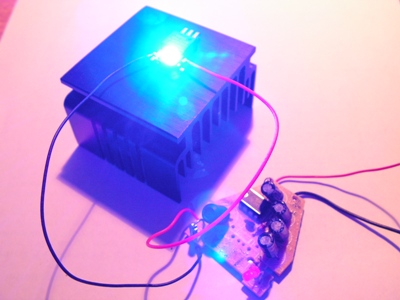
A
relatively newer generation of LEDs known as Luxeon
LEDs offer seriously high brightness in a seriously
compact package. Pictured is a Luxeon I bought a while
ago mounted on a makeshift heatsink (used transistor). |
The Luxeon
I bought came with a current limiting driver board,
seen pictured here along with the Luxeon and associated
heatsink. This particular model is rated at 5W and
dissipates plenty of heat while operational.
The light
output is tremendously bright and is painful to look
at with the naked eye.
|
|
|
These
LEDs are quite fun as they very close to an ideal point-source
of light. This means all sorts of eerie shadows can
be produced - such as the one here with a 'duplicated'
apple. |